- 5th November 2026
- By Victorian Women's Trust
Webinar Recording | Gender and AI: Where is the Harm?
- VWT News
- Tech and Gender
- Policy and Rights
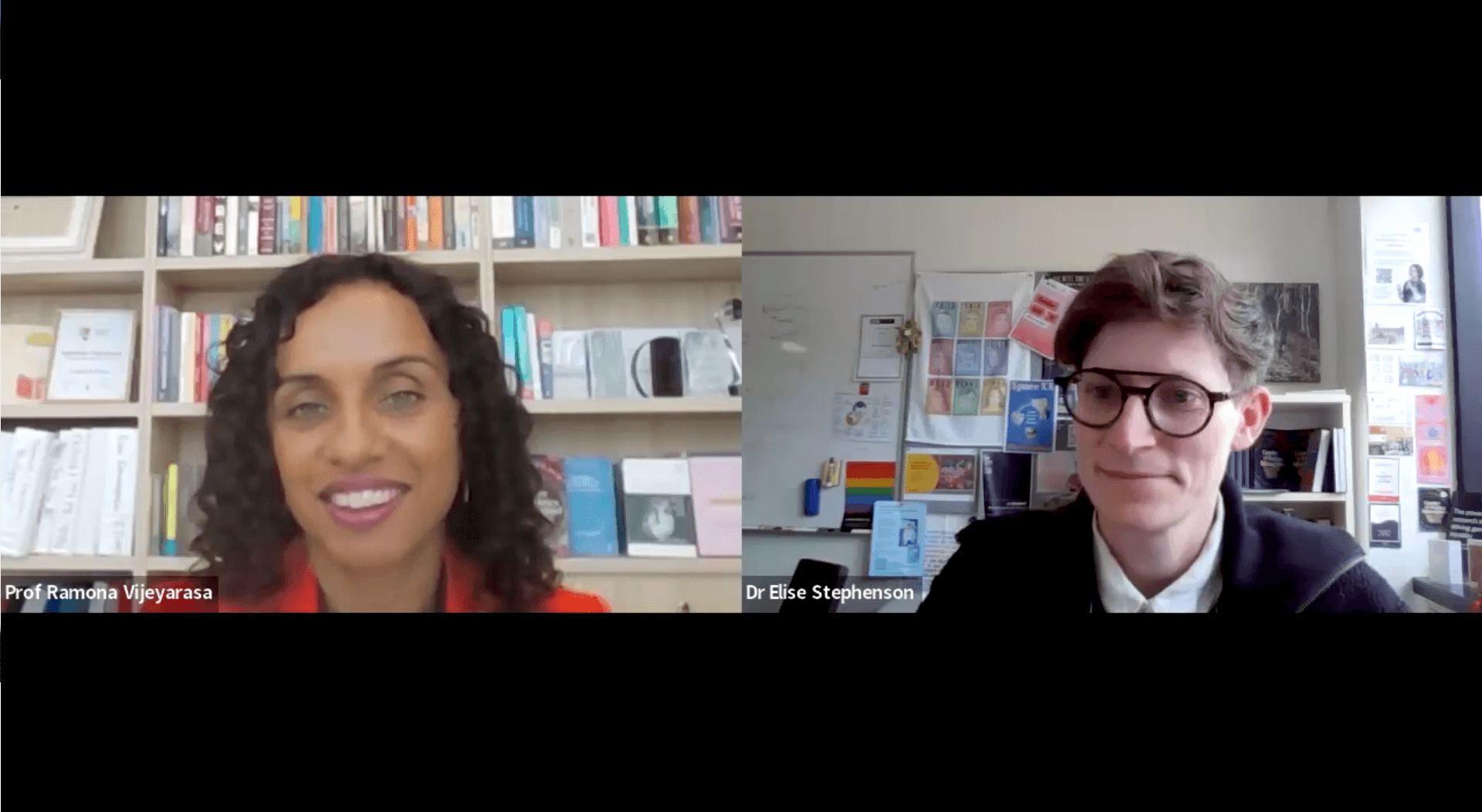
On Thursday 15 October 2026, the Victorian Women’s Trust hosted a conversation on one of the most urgent questions of our time: what does the rapid rise of artificial intelligence mean for women, girls and gender-diverse people?
The webinar marked the release of our Research Snapshot, Gender and AI: Where’s the Harm?, authored by our inaugural Feminist Researcher in Residence, Dr Elise Stephenson. The Snapshot maps 20 interconnected gendered harms of AI, from deepfake abuse and biased data to the chilling of women’s political voice. It shows why these harms can’t be treated as a collection of isolated technical failures.
Elise was joined by Professor Ramona Vijeyarasa, whose work centres around who is harmed, and what solutions does the law offer. Together they explored where the harms are, why Australia’s approach to AI remains largely gender blind, and what each of us can do about it.
This conversation is the foundation for our White Paper, to be released in 2027.
Speakers:
- Dr Elise Stephenson – Deputy Director of the Global Institute for Women’s Leadership at the Australian National University, Australian Research Council DECRA Fellow, and the Victorian Women’s Trust’s inaugural Feminist Researcher in Residence
- Professor Ramona Vijeyarasa (moderator) – Professor in the Faculty of Law at the University of Technology Sydney, inaugural Chair in Gender and the Law, and creator of the Gender Legislative Index
Content note: This discussion includes references to technology-facilitated abuse, sexual violence, deepfake pornography and coercive control. Please take care.
If this conversation raises anything for you, support is available:
- Call 1800RESPECT on 1800 737 732, or visit 1800respect.org.au
- Visit esafety.gov.au to report image-based abuse and other online harms
How is AI is showing up in your life, work and community? Share your thoughts and help shape a feminist policy response to AI.
Who can participate?
People 18+ of all genders and backgrounds are encouraged to participate. We are particularly keen to hear from policymakers, experts or community leaders, however, we welcome a range of perspectives no matter your background. Your responses will help inform our forthcoming White Paper to be be released in 2027. All answers will be treated confidentially. Identifying information will be removed. Learn more →
Additional resources
- Gender and AI: Where’s the Harm? – Research Snapshot (published by the Victorian Women’s Trust), Dr Elise Stephenson
- SpaceXX: Gender, Power and the New Space Race – Dr Elise Stephenson
- Gender Legislative Index – UTS, Prof Ramona Vijeyarasa
- Gender and the Law Programme newsletter – UTS, Prof Ramona Vijeyarasa
- Inclusive AI Pledge – Champions of Change
Transcript
This transcript has been lightly edited for readability. Please check against the recording before quoting.
Professor Ramona Vijeyarasa:
Good afternoon, everyone, and welcome. It is an absolute pleasure to join you on behalf of the Victorian Women’s Trust. My name is Ramona Vijeyarasa, and I’m a professor in the Faculty of Law at the University of Technology Sydney, where I hold the inaugural Chair in Gender and the Law.
The question before us for today’s conversation is: Gender and AI, where’s the harm? I think we all know it’s an urgent question. We’ve had so many people interested in today’s conversation, and I think that’s a reflection of that urgency.
AI is being rapidly embedded in the institutions, technologies and everyday decisions that are shaping our lives. It’s influencing what we see, the information we receive, the opportunities available to us, how we are assessed and how decisions are being made about us. And this is happening at a moment of profound backlash against women’s rights, gender equality, diversity and inclusion.
AI is not entering an equal world. It’s entering societies where we know the institutions, the labour markets and the legal systems are already distributing power and opportunities in really unequal ways. So unless we intervene deliberately, as we are doing today, AI is reproducing those inequalities, accelerating them, and making them more difficult to see and challenge.
So a great deal of important work is about making those gendered harms of AI visible, which is the topic of today’s discussion and of this excellent Research Snapshot produced by the Victorian Women’s Trust and authored by Elise, who I’m in conversation with today.
My own work tends to begin with the question that follows: once we see the harm, what should the law do about it? It’s not simply a question of whether we need more regulation; it’s a question of what kind of regulation we need. The law can apply the same rules to everyone and still fail to recognise who experiences harms most acutely, whose interests remain invisible, and who can realistically obtain a remedy.
So I’m hoping today’s conversation brings together two closely connected tasks. The first is to identify and understand the gendered harms of AI. The second is to consider how we translate that understanding into accountability.
But before I begin, I would like to acknowledge Country. I can see we have guests joining from all around the world, which is incredibly exciting. I’m joining from the University of Technology Sydney Faculty of Law, which is situated on the unceded lands of the Gadigal people of the Eora Nation, and I pay my respects to Elders past and present. At UTS, we acknowledge that these lands have always been places of law and continue to exist in plural legal worlds.
For those less familiar with Australia, today is also the 15th of October, the International Day of Rural Women. It’s a day that recognises the vital contributions rural women, especially Indigenous rural women, make to things such as food security, rural development and biodiversity.
I think this is really relevant to our conversation today, and I’m sure Elise agrees: debates about gender and AI can’t just be about who has access to the tech. For rural and Indigenous women, digital systems so often draw upon their knowledge of land, Country and communities without adequately recognising it or getting their consent. A genuinely rights-based approach in this digital world is not just about digital access, but about Indigenous sovereignty over knowledge and data, and self-determination.
So with that in mind, it is my pleasure to introduce my friend and colleague, the wonderful Elise Stephenson. I don’t think Elise needs much of an introduction, but she’s the Deputy Director of the Global Institute for Women’s Leadership at the Australian National University, and an Australian Research Council DECRA Fellow.
Her research examines gender inequality at what I think are three fundamental emerging policy frontiers: AI, space and climate. Elise has just released her book SpaceXX: Gender, Power and the New Space Race, and I urge you all to get a copy. I had the privilege of reading an early copy, and I think it reflects what makes Elise’s scholarship so compelling: this capacity to bring gender, power and inequality to fields that are so often treated as purely technical, neutral or somehow beyond politics.
Elise is also the inaugural Feminist Researcher in Residence at the Victorian Women’s Trust. As would be expected of the Victorian Women’s Trust, this residency is not concerned only with documenting inequality; it’s designed to turn rigorous feminist research into advocacy and practical change. The Research Snapshot we’ll be hearing about today is the foundation for a White Paper that will be released next year.
So we’re going to discuss the Research Snapshot, Gender and AI: Where’s the Harm? It maps 20 interconnected gendered harms and shows why they can’t be treated as a collection of isolated technical failures.
Elise, a warm welcome. Let me begin with the question I think is at the heart of this Snapshot: what were you trying to uncover through this project, and what surprised you most when you did this research?
Dr Elise Stephenson:
Thanks so much, Ramona, and thank you to everyone who’s joined us, and to the Victorian Women’s Trust for backing this research in the first place. I’m joining from Ngunnawal Country in Canberra.
You mentioned my broader research agenda, which has picked up what could be seen as unrelated domains: space, AI, climate change. But actually, they’re deeply related, and they go to the heart of a question I’ve pondered for some time.
The way I see it, we are at a critical juncture. We’ve got new institutions emerging, new rules, new policies, new legislation, new departments. We have a flood of resources and funding going into areas like artificial intelligence and other technological advancements.
I’m a political scientist and an international relations scholar, and what we study is institutions. We see these moments, where you’ve got new institutions, a flood of funding, new resourcing and new actors, as critical junctures. As the theory goes, new institutions created in more gender-equal times should be more gender equal. I really wanted to critique and question that. Are we always doomed to repeat inequalities, or can we do things better? Can we learn from past mistakes and injustices, and create better pathways forward?
So this Victorian Women’s Trust residency has been a real pleasure, and an opportunity to stretch the work I’ve been doing and look specifically at mapping the gendered harms of AI at a systems level. You might hear a little about data centres over here, deepfakes over there, maybe biased LLMs. You often hear about the challenges of gender and AI, or AI more broadly, in silos. What I felt was missing was a connected picture. What are the structural ways in which AI is enhancing or embedding inequality? And of course, how can that be disrupted?
That overarching picture has underpinned the research, along with the search for feminist leverage points within this system. We don’t have to do it the way we always have. Taking an explicitly feminist approach to AI might include challenging the neutrality of technology, really revealing that technology isn’t neutral. It reflects who makes it, the biases that are built into it, and society more generally.
It also means recognising that not all forms of technology are inevitable. Think of nuclear technology: there are really heavy guardrails around some forms of technology, for good reason, because they may have significant consequences not only now but far into the future.
So for me, it’s about mapping those harms at a structural level, identifying the feminist leverage points, and thinking in an integrated, intergenerational way about what a feminist approach to AI looks like for our world.
Professor Ramona Vijeyarasa:
I want to dig into those mappings and ask why it was time to bring it all together. But first, I’d love to hear more about those feminist leverage points, because I think that will get everyone excited. I see the idea that technology isn’t gender neutral written all the time now. People are recognising it. But then, what next?
Dr Elise Stephenson:
Absolutely, and this is a big part of the opportunity. There were siloed pockets of research here, there and everywhere, and this project tries to bring these 20 gendered harms together. I recognise it’s not exhaustive. I’m actually hoping people take this work and add to it or tweak it. It’s a starting point more than anything else.
What it allows us to do is see the problem clearly. As you said at the start, in order to find leverage points, you have to understand the root causes and the nature of the problem.
One thing I’ve encountered in a lot of my research is that we might have gender expertise over here, artificial intelligence expertise over here, and policymaking expertise over here, but very rarely do you find people at the intersection. And that’s for a reason. Although artificial intelligence has been around for decades, in recent years we’ve seen a real ramping up of its use: the mainstreaming of large language models and chatbots, and integration into physical products like fridges, cars and TVs. That makes it much more prevalent and changes our interaction with it.
Even so, there’s an emerging evidence base, and that’s something we’ve tried to capture in the Snapshot. Some of the harms are absolutely already here and have a strong, substantive evidence base, which we can make policy on immediately. Some of the harms identified are more theoretical. They could happen, even if they haven’t yet, and they warrant inclusion because of how devastating they would be.
So I’ve tried to map across the strength of evidence, the severity or significance of the harm, and the durability of the harm. When we launched the publication last week, I used the example of a chatbot that misgenders you. That harm might be relatively easy to fix by training the chatbot not to do it. Its durability isn’t as persistent as, for instance, AI or LLM models that have been built on biased datasets and continue to reinforce norms that exclude women, or First Nations voices, or whoever it might be. That might have a much longer-term impact that takes a lot longer to change.
So across those harms, the leverage points look different. What I’m hoping comes next is, firstly, we’re going to run some workshops and get people in a room to map out some of the policy options. But I also hope that people, wherever you are in the world, read through this research and say: for my community, we could do this to start addressing this point, say in schools. Or for those working in industry: what can we change in our development practices, or our hiring practices? I can help collate some of those leverage points, but I’m also hoping the community takes it upon themselves to identify some feminist leverage points too.
Professor Ramona Vijeyarasa:
Excellent. I think that’s a really empowering opportunity for many of our listeners. The examples you gave hint at the diversity of the issues at hand. We tend to talk about AI as an umbrella term, and now we’re talking about the gendered harms of AI, but there’s a lot within that umbrella. You’ve talked about chatbots that misgender, about LLMs that rely on biased data, perhaps making decisions about education access, finance, or whose CV makes it to the shortlist pile.
What has been the risk of looking at these in a siloed way, and what’s the value of bringing it all together to talk collectively about gendered harms?
Dr Elise Stephenson:
Looking at it in a siloed way is what we’ve seen to date in Australia, as well as in many global counterparts. You’ll know this better than I do, but often one department deals just with copyright issues, while another regulator deals with image-based abuse and deepfakes.
That’s fine, but lacking a more holistic approach to the gendered harms of AI reflects our broader governance and policy approach, which is: we’ve got gaps, and things might be missed. What I don’t want is a siloed approach that treats deepfakes as the issue, where it starts here and ends there. By looking so narrowly, you might miss all the preceding factors that enable it, and all the other ways harms are embedded across the ecosystem.
So I would love it if this weren’t just the responsibility of tech departments and certain regulators, but if there were a more mainstreamed approach, where society has a way of looking at AI and understanding both its opportunities and its harms.
The interviews and focus groups I’ve done so far have revealed a few things. Something a lot of women kept telling me, which absolutely needs further research to establish prevalence, was: “I’m taking on the AI mental load here. When it comes to thinking about the ethics of AI, I seem to be the only one thinking about it. I don’t see industry thinking about it. Sometimes I don’t see my male colleagues thinking about it as much, and I’m worried about that.”
That’s a replication of what we see elsewhere in society when we talk about the gendered mental load, the unpaid caring burden and so on. What I’m hoping to show is that this isn’t removed from what we see in society more broadly. It’s an extension.
The way we theorise it at the Global Institute for Women’s Leadership is that technology is a tool that can change the nature or prevalence of harm. And there are things we can do, because technology isn’t something innate that just arrived in the world. It’s something we created and co-create at every juncture. So by seeing the interconnected harms, we can also see how small, interconnected tweaks here and there can help create a more just, equal and sustainable future.
Professor Ramona Vijeyarasa:
Thanks, Elise. I find that example about the mental load really interesting, and very reflective of what the scholarship already says. Women make up only around 20 to 22 per cent of PhD graduates in AI and computing science in the US. In response, Susan Levy, a computing scientist, has made a strong push for more women at the table. Many say that just having more women at the table won’t, in and of itself, be the answer, and we know that.
But she points out that the vast majority of scholars talking about the gendered harms of AI are in fact women and gender-diverse people, partly because of lived experience, and partly because we’re bearing the responsibility to bring these issues to the table. So she says: if we’re the ones conscious of it, because of our lived experience, we need to be at the table to raise it. So there is evidence that women and gender-diverse people really are carrying the mental load of these issues.
In the report, the harms are described as a cascading system, which I think should alarm us and make us take this really seriously. I also like that you talked about AI as something we’re creating and co-creating, because it raises the reality that this space is changing so fast.
Companion chatbots are on your scale in terms of severity and significance, and I think they’re a really interesting example. Someone in my team has studied companion chatbots that enable the simulation of rape and sexual violence and situations tantamount to slavery, both those that were designed to do that and those that weren’t. It’s an alarming but real example of how quickly these technologies, even in the space of one year, have learned to do things we didn’t anticipate.
So can you tell the audience about your cascading system or classification, and how we’re meant to understand the severity and significance of these gendered harms?
Dr Elise Stephenson:
Absolutely, and you can look into this more in the Snapshot. One thing I didn’t want to create was a hierarchy that says this harm is definitely lower in severity or significance than that one.
In conceptualising this, I’ve drawn on a lot of evidence bases and various theorists. At the lower end of the spectrum might be harms that affect fewer people, or involve a lower intensity of suffering or disadvantage, which again is pretty subjective, so we’re talking about really broad categories. Maybe a harm has a lower impact on rights, autonomy, freedom, safety or opportunity, or a lower impact on reinforcing structural inequalities. Those at the higher end are higher on all of those things.
The big caveat is that this really depends on how the technology is used, and on the individual. Acknowledging intersectionality, some groups may find certain harms far more significant or severe, with a far greater impact on their rights. So it’s a really broad classification, which I’m looking forward to others building on.
In terms of the cascading nature of harms, we’ve talked about a few of these already. Women’s representation in the AI sector in Australia is about 30 per cent, and that decreases quite rapidly at senior executive levels and among lead professors and academics working in this space. Then there are concerns around ethics, and biased LLMs. I’m not drawing direct causal links, but I’m showing what we know.
We’re also seeing women opting out of using AI. Because they’re not opting in, they’re not able to help train these systems, so the systems can’t learn from perhaps more feminist or more ethical approaches. Given the biased nature of these systems, we’re seeing disinformation, misinformation and biased advice on a whole host of issues.
For instance, one study in Australia found that while men and women use AI similarly for medical and health advice, women tend to ask questions that would require more specific expertise, or relate to more severe health issues. That should concern us.
Then there are biased systems and how leaders are represented. There have been great studies, which I’ve included in the Snapshot, showing women pictured as less likely to be leaders, or as more demure or submissive, depending on where you’re based in the world. With image generators, women are often not included in certain occupations, or are depicted stereotypically, as sex workers or cleaners, or are sexualised.
Then you look at deepfakes, and you see this picture building. Around 97 per cent of all deepfakes are pornographic, and about 99 per cent of those are of women and girls. This is horrendous.
Then link that to political representation, and you see the targeting of leaders. Just in the last week, a huge number of European women politicians have been targeted by an onslaught of AI-generated pornographic deepfakes. This is horrendous.
So then you see a chilling effect. We’ve done a lot of research at the Global Institute for Women’s Leadership with women who are politicians or aspire to be, and with young people, gender-diverse, First Nations and LGBTIQ+ people. One of the top reasons they opt out of a political career, or out of taking more political action, is a lack of safety, especially online safety: a fear of being targeted, doxxed, or having deepfakes made of them. And that fear hasn’t come out of nowhere; it reflects a really common practice we see in the world. That’s what I mean by this cascading effect.
The other interesting thing that came out of the research was: what does it mean when we rely on AI so heavily for social interactions? Whether that’s on Bumble, Grindr or Tinder: “Help me answer this message to whoever I’m courting.” You can tell I’m married and haven’t dated in a really long time, I’m so sorry! But this socially mediated AI reliance, where you feel you have to rely on AI, what does that do to human relationships over time? Some of the youth advocates I talked to raised the same concern about the rising prevalence of AI-generated companions.
So I’m really interested in how AI mediates our norms and our behaviour, and whether it reinforces the gendered inequalities we see more widely. When you see that picture, it’s pretty frightening.
The big caveat is that this Research Snapshot focused on harms for a reason. I acknowledge there are huge opportunities, and that’s something we’re hoping to go into in the full White Paper. But it felt timely and important to start with the harms. A “do no harm”, harm-prevention approach is really important, particularly in this era of backlash and, in some instances, regression. I think we need to keep the focus on the harms and not gloss over them before we jump to the opportunities.
Professor Ramona Vijeyarasa:
I couldn’t agree more. What’s exciting in this space is the growth in data and research documenting the kinds of harms you were talking about, such as the representational harms of gender-stereotypical large language models, natural language processing, and very feminised virtual assistant chatbots.
The dating space is something I’m less familiar with day to day, but there’s a fantastic new study released by the Behavioural Insights Team, funded by Minderoo, on the extent of technology-facilitated gender-based violence on dating apps. So I’m excited to see this massive growth in knowledge and data about the harms, and I really agree with you: once we know enough about the harms, we can start talking about the response.
Dr Elise Stephenson:
Absolutely. And I do want to put some questions to you too, because you’ve been working on the Gender Legislative Index for years now, and it’s recently ramped up with a specific focus on artificial intelligence and technology. You’ve assessed how these laws respond to gender. How gender responsive do you think Australia’s approaches to AI are?
Professor Ramona Vijeyarasa:
You’ve already hinted at this, Elise: there’s a risk when we regulate certain spaces or focus on certain issues, say non-consensual image-based abuse, without a holistic picture. So my short answer is: not nearly gender responsive enough.
Through the Gender Legislative Index, the team at UTS and I ask whether laws adequately respond to the different ways legislation is lived by men, women and gender-diverse people. We don’t only ask what a law is trying to achieve, but whose experiences are visible in it, what obligations it creates, what remedies will be genuinely accessible, and what its likely effect will be.
We’re now applying this to AI, and I think it couldn’t be more timely. We’re looking at more than 80 laws related to online safety and AI. It’s not that Australia is devoid of regulation; we have fragments of legislation, but I think it’s largely gender blind.
We don’t have a comprehensive, economy-wide AI law. Instead, our legislation is spread across online safety, privacy, anti-discrimination and criminal law, much like other jurisdictions that take a sporadic approach rather than an omnibus act.
When I say it’s gender blind: it’s really problematic when lawmakers treat a subject as gender neutral, the same way some people treat tech as gender neutral, in ways that ignore the evidence that the harm, its severity and the barriers to redress are all shaped by gender. We know women and girls are disproportionately targeted by synthetic sexual abuse, misogynistic harassment, other forms of tech-facilitated violence, and AI-generated stereotyping. Refusing to name women and girls as particular victims of these harms, as particularly vulnerable and at risk, doesn’t make the law fairer by treating everyone the same. It makes those most affected less visible.
Here in Australia, it’s often celebrated that in 2024 we got a federal criminal law on non-consensual sexual material, and in that law it doesn’t matter whether the material is real, altered or entirely fabricated; it’s all captured, which is great.
But criminalisation is only one part of an effective response. If you talk to someone affected by non-consensual image-based abuse, prosecution can take months or years, while an image can circulate in minutes. As a lawyer who loves and respects the law, I’d say sometimes the law is just too slow.
So in a legal response, you want to be asking: can the material be removed faster? Can you do something when it’s re-uploaded? Is the victim’s identity protected when they complain, so there’s no retaliation? Are there specialist support services? Do they have access to legal aid and psychosocial support? That comprehensive approach, I think, is missing.
There’s huge excitement around the proposed Digital Duty of Care, and I definitely support the shift it represents: not waiting until the harm occurs and placing the burden on individuals to pursue a remedy, but placing the burden on internet service providers, AI providers and platforms.
But in my view, the draft bill, tabled in September 2026, is gender blind right now. Here’s an example. The bill speaks to encouraging hostility towards women and gender equality. That sounds really exciting, but the bill only treats that as a problem if it’s harmful to children. It doesn’t treat that language as a problem for the whole of society, for women. In that sense, it’s gender blind, and an entirely missed opportunity to centre technology-facilitated gender-based violence in gender-responsive reform.
Australia wants leadership in the digital space. We were the first to lead with the social media ban, and I think we could lead here too, but we really need to see this bill turned around into something far more gender responsive.
Dr Elise Stephenson:
Absolutely. A lot of the discussions I’ve been part of talk about all the permissive stuff, the “lawful but awful”, that won’t be captured by that law, so there’s still so much that’s needed.
Youth advocacy groups have also been really concerned about the prevalence of deepfake pornography among school children, where the perpetrator and the victim are both minors. They aren’t adults in the eyes of the law, so is a criminalisation approach really what we want in the first instance?
I know we have some people from the Department of Education on this call, and it’s great to see you here. This is a big challenge schools and the education system are grappling with: how do we work not just on the legislative side but on the social norms side, on what is and isn’t acceptable use of AI? I think there’s a lot more conversation to be had there.
Professor Ramona Vijeyarasa:
That’s an incredibly important example in a country with far too young an age of criminal responsibility. When the minimum age of criminal responsibility is 10, and a child in late primary or high school makes a deepfake, that will sit with them forever. I don’t think we can compare that harm to an adult, who should know better, doing it at scale. So it is a really real conversation.
When it comes to the role of the law, lawmakers, legislators and legal drafters can be quite narrow in what we expect of legislation. Yet countries such as Argentina and the Philippines have online safety laws that talk about education, and about gender equality and technology-facilitated gender-based violence as a core part of what everyone in society should be educated about. So I think we want to bring that education conversation into lawmaking, and expand both what we expect to be protected against and what rights our laws protect.
Dr Elise Stephenson:
Absolutely. In Australia, we’ve been seeing a lot about data centres recently, and there’s often a focus on productivity gains, at least for certain segments of the population. What do you see as the least talked about but most urgent areas of AI? And do you have any policy recommendations, or a recommendation wish list?
Professor Ramona Vijeyarasa:
It’s interesting, because if you ask what’s least talked about, you have to dig, because right now the discussion is gravitating towards two extremes. On one end, there’s the existential fear that AI is going to ruin the world, with agents that will destroy everything we take as a given. On the other, there’s the narrative that AI promises us faster, more efficient, more productive workdays.
I’m a user of AI and a huge believer in its potential. But I think those conversations at the extremes distract us from something in the middle that worries me more: what is AI already doing to people whose lives are already shaped by unequal institutions? That’s where the gender question comes in. It’s the everyday that worries me.
As a result, much of the law and policy debate is focused on bias. Is the dataset representative? Well, no, it’s not; we’ve known this for a long time. Caroline Criado Perez’s book told us, if we needed evidence. Does the algorithm discriminate? Very likely it will. Can we remove gender from the inputs and make the tech fairer? Yes, we probably can.
Those questions are important, but I don’t think they’re enough. The focus on bias means we forget the structural nature of the problem, and recruitment is a really good example. You can take an AI tool used for employment decision-making and remove names (Elise and Ramona being fairly female-identifying names) and other gender markers. But the system will still probably reward a CV with uninterrupted full-time employment, and downgrade a CV with a history of part-time work and caring responsibilities, because all of this is happening in an unequal society.
So I’d love to see the conversation focus less on de-biasing the data and the algorithm, and more on substantive equality, taking this as an opportunity to build an AI tech world that operates with substantive equality as its broader goal. If not, these automated systems will produce inequalities at scale across employment, education, credit, healthcare, and the list goes on. To me, that’s a really silenced aspect.
As for my policy wish list, I’d go back to the Digital Duty of Care, because I think it’s the opportunity right now. If I could say three things about the bill:
First, once it’s tabled in Parliament, I’d love to see the bill name technology-facilitated gender-based violence as a problem, define it comprehensively, and name CEDAW obligations. Nearly every country in the world has ratified CEDAW, so all 189 of those countries are bound by what CEDAW has said about the gendered harms of AI.
Second, platforms are often told to do a risk assessment. We’ve seen in other spaces that a risk assessment lets big tech and corporations tick a box and have a compliant assessment, but they’re not being asked to do gendered risk assessments. If your research and others’ research is showing the gendered harms, risk assessments must be gender responsive. They need to disaggregate data across disability, race, Indigeneity and sexuality, so we understand the compounded effects on a diversity of women and girls.
Third: can we deliver remedies at the speed of digital harm? Talk to anyone who has experienced online harm, especially a deepfake, though we don’t want to narrow the issue: violent or harassing comments, partners using tech platforms to perpetrate abuse or coercive control, non-consensual image-based abuse. The harm is immediate, and it’s escalating. We need remedies that operate at the speed of digital harm.
Dr Elise Stephenson:
I agree 100 per cent. What you said about de-biasing AI reminded me of when people say, “I don’t see race.” It’s the same sort of thing: it’s still there.
Professor Ramona Vijeyarasa:
We actually do see it.
Dr Elise Stephenson:
Right. And actually, we want to both acknowledge it and look at ways we can combat unequal or unjust systems. It’s not about stripping that out and making it invisible. So I think that’s an apt comparison.
Professor Ramona Vijeyarasa:
I’m conscious of the time, and I’d love to hear from our audience, so let’s take some questions. Once we’ve done that, we might offer our very active audience some tips.
Elise, the first question is: what are schools doing to address the harms of AI? Do you think there’s enough going on?
Dr Elise Stephenson:
My recent research didn’t look specifically at different schools’ approaches. But from working with various youth advocacy organisations and across government, I know there is general fear, and there have been attempts to combat some of the harms we’re seeing, particularly technology-facilitated gender-based violence and deepfakes. Some of you may have seen State of Man on the ABC, by Mark Fennell, which starts to go into what’s happening in schools.
In general, though, from what I’ve seen in the research, we’re still looking at a siloed and ad hoc approach. What I haven’t seen much of is a national conversation: what kind of Australia are we hoping to create, and how do we integrate these new technologies? Whether it’s the technology we see now or whatever comes in the future, how are we establishing norms around acceptable and unacceptable use?
In the civil and military domains, there’s the concept of dual-use technology: any technology that could be used for a civil purpose or a military purpose. That generally comes with quite specific guidelines. I’m not seeing that for many AI applications, even though they are dual use in a similar way. AI can be used positively in so many ways, and going back to our understanding of technology as something that shapes the nature, severity and prevalence of harm, I think there’s still a lot of space we’re missing. I’d love to have further conversations with anyone in the education space who is wondering what to do. I think there’s an enormous opportunity there.
Professor Ramona Vijeyarasa:
Absolutely. A couple of weeks ago, UTS hosted the Australian Public Policy Institute’s annual summit, and lots of people from the Department of Education were involved.
I’d add to everything Elise has said that we live in a country where gender equality is not taught in schools from first principles. We’re not teaching misogyny, what kind of society we want, and women’s rights from kindergarten through to Year 12. We don’t live in a country where human rights language is part of the day-to-day norm. So I think we’re playing catch-up.
Consent education comes far too late, and in many schools it happens for a day or two rather than being embedded throughout. And suddenly we’re talking about risks for young people online, about young people being exposed at a very early age to pornography that’s often harmful rather than sexually empowering, at an age that’s not appropriate. So we need really serious conversations about what guidelines will govern our schools.
In New South Wales, the Minister for Education is proposing a reduction in the amount of time children spend online. The entry point there is that our students aren’t as well educated as their peers, based on PISA scores. But it’s an entry point for proper conversations about tech: not just what the best learning opportunity is, but what we’re exposing children to when they freely use these online tools. I think we should use those entry points to have those conversations.
Tanya Kovac has joined us and asked an excellent question. To paraphrase, Tanya, if you don’t mind: it’s really easy to pay lip service to gender these days, and we want to have really serious conversations about gender.
I’m happy to jump in first. When I made a submission on the Digital Duty of Care, a dear colleague of mine said: “I definitely know all about your work, I promise, but I finally understood what you mean by gender-responsive legislation when I read your submission.” It got down to the specifics: we need to add this word to the draft bill, define these terms in this way, use CEDAW as a governing framework the same way we use the Convention on the Rights of the Child in several pieces of Australian legislation.
So one way to get beyond lip service is to make the conversations as substantive and evidence-based as possible. That’s why our team, as part of the Gender and the Law program, is also digging up examples of how other countries are responding, with really specific provisions from their laws. That way, it’s not easy for policymakers or legislators to say “we’re doing this” when we know they can do it much better.
Elise, did you have anything you wanted to add?
Dr Elise Stephenson:
I completely understand and empathise, and feel a lot of solidarity with, and disappointment in, the current system. We’ve had major defunding of some of the innovation programs that could have been an open door for more women, gender-diverse and First Nations people to get into this sector and make an impact.
Speaking more generally, not about AI startups specifically: in Australia, female-only teams received about 2 per cent of all venture capital funding, down from a record high of 4 per cent the year before. That’s just entrepreneurship. If you look at women’s organisations and so on, we’re seeing a hollowing out, and some of this follows what’s happening in the US under Trump. We’re certainly seeing it in international development.
It’s hard to know what the solution is without those in power and with funding taking this seriously, and that is the absolute call to action that needs to be made. I know we have only a small pool of philanthropic funding in Australia, but wherever possible it should be used in really gender-transformative ways. That’s a strong leverage point.
Government also has mandates here. Since about 2022 or 2023, the Australian Government has had guidelines requiring every new policy proposal or Cabinet submission to go through a gender analysis. If it meets a certain threshold, which Professor Leonora Risse and I have argued anything to do with AI does, it needs a more detailed gender impact assessment. That should trigger adequate funding, resourcing and gender-responsive policy provisions on this issue.
But in my research so far, I’ve heard all kinds of stories that really worry me. Some government areas aren’t doing it, saying that things like AI impact everyone and therefore don’t require a gender analysis. That’s a fundamental misunderstanding. On the other hand, I’ve heard of departments that are required to do these analyses putting it into AI, so you get whatever biases come out of that system. It might be good, it might not be, and it doesn’t replace actually talking to women and to experts in this sector.
So the way I see it, we really do need to partner up, and Leonora and I certainly have actions to keep this on the agenda.
More generally, we’re seeing a lot of polarisation in society right now. I live in a small rural community in New South Wales, and I certainly see it there, let alone more broadly. So it matters to keep gender on the table. Global research shows that as you get closer to equality, that’s often when gender equality is most at risk of stagnation or backsliding, under the idea that it’s already been achieved or isn’t an issue. Some great research shows that those who believe gender equality has already been solved are most at risk of perpetuating inequality. That’s a real worry for me. Addressing the defunding of women’s organisations, of innovation, and of AI pathways for people who look different from the historic norm is a priority, for sure.
Professor Ramona Vijeyarasa:
Excellent, Elise, that was a great and compelling response. I’ll throw to one more question before I put a question back to you.
Eliza has asked an excellent question: so often, AI-generated content won’t fit into a category of explicitness, and so it escapes the law. An image is created that another person doesn’t want to be pictured in. How do you police this?
It’s a really great question, and a lot comes down to content moderation, specifically gender-responsive and culturally responsive content moderation. Just because something isn’t explicit, or labelled explicit, and so doesn’t fall into a “harmful” category, doesn’t mean it isn’t causing someone harm, or wasn’t created against someone’s consent.
Australian legislation actually has a really interesting inclusion: it recognises that when someone who would normally wear cultural dress is pictured without it, that can be harmful content for them, because it can have huge repercussions, including cultural repercussions as severe as honour killings. The fact that Australian law recognises that is incredible.
What we want is for platforms to think about this when they create their tools in the first place. That’s what is often meant by safety by design, or ideally equality by design: thinking about what the experiences of an individual on the platform might be. Should there be automatic tagging? Should someone be able to consent before an image of them appears online and in the public domain? So, great question, Eliza.
Elise, my question back to you is really one for our audience. The Victorian Women’s Trust has done a great job of bringing us together today, and really wants practical outcomes from its work. We have a huge diversity in the audience: experts, people clearly quite close to government, and people experiencing AI in their everyday lives. What advocacy actions would you recommend anyone listening could take to do something about these gendered harms?
Dr Elise Stephenson:
I’ve got a few suggestions. First, there are opportunities like parliamentary submissions. It sounds a bit boring and nerdy, but hopefully you’re all here because you care about policy or impact in some way. Submissions can be a really effective way of ensuring your views, your research and your organisation’s priorities are reflected in policy.
Let’s not forget that industry has very well-paid lobbyists making submissions and lobbying all the time. I’m really conscious that we need to band together as a community and have our input. Ramona and I, Professor Leonora Risse, the Victorian Women’s Trust, the Wiyi Yani U Thangani Institute for First Nations Gender Justice and a group of other organisations recently put in a submission on gender and artificial intelligence. I welcome anyone to write to me and say, “Can I join one of your submissions?” or “I’m happy to participate, but I need some more support.” That’s one really great avenue.
Second, the Snapshot is out. What are your responses? What do you want to see done? Email or find another way to share your thoughts and perspectives with us. We’ll also be holding a roundtable discussion and workshop in Victoria in November. Write to us and we’ll see if we can squeeze you in, as a way to provide input into our White Paper, which will go into more detail on policy options that governments and communities might take up.
And more broadly, have conversations with your family, your friends, your neighbours and your community, even those who may not share your perspectives. Some of this is consciousness-raising. It’s a literacy campaign, a dialogue about what may or may not be known in the community.
Ultimately, I want platforms to be far more responsible, as Ramona has said, and I want policy and legislative responses to be better. But they will only ever be as good as our community. We have to change some norms around AI use, and we have to have critical conversations, not just with young people but across all generations. Those would be my actions. Ramona, do you have any you’d add for our audience?
Professor Ramona Vijeyarasa:
I do, although all of yours are great and really speak to what it means to live in a democracy. We have to believe we can change the current state of play.
I’d give a shout-out to Nadia, who mentioned the Inclusive AI Pledge in the comments. Some of you may know Champions of Change created the Panel Pledge, so that when you see a male-only panel at a conference or event, you can call it out. The Inclusive AI Pledge is a commitment to make the way you use AI every day more inclusive.
The link Nadia shared includes a prompt you can use. I use AI almost every day, and the prompt lets you tell your AI: “I don’t want you to bring out biased data. When you write an agenda, suggest speakers, summarise an issue or generate research for me, I want you to acknowledge that there are biases and to challenge them.” It’s a self-empowering tool that gives us back some power, in the hope that we can change the way the machine is learning. So a big shout-out to the Inclusive AI Pledge.
Second, ask harder questions when AI is introduced. Some of you may work in workplaces that have introduced AI. You might be required to use it, perhaps an employment decision-making tool for recruitment, or you might be encouraged to use AI for research or to be more efficient. Ask the hard questions. Has this tool been tested for its gendered impacts? If you work in a bank, or in education selecting applicants, will a person affected by an AI decision be able to challenge it? And who in your organisation is accountable? It’s important to find ways to ask these questions.
Third, in addition to writing submissions, which I strongly endorse while fully appreciating how much work they involve: use your vote. There’s an election coming up in New South Wales on 13 March, and in Victoria next month. Ask candidates what they actually think about technology-facilitated gender-based violence, algorithmic discrimination, and big tech and corporate accountability. Don’t just ask the easy question, “What are you doing to support AI for innovation?” Ask what they’re doing to support inclusive, accountable and gender-responsive innovation. Being in an election period in a couple of states is a really wonderful opportunity.
Elise, you’ve already mentioned a few things coming up. We’d love to hear more about the roundtable and its outputs. Here at UTS, we have the Gender and the Law Programme, including a newsletter, so do sign up to hear about upcoming opportunities in the AI space. And I hope you’ll all be watching the Digital Duty of Care Bill as it progresses.
A huge thank you again to the Victorian Women’s Trust for organising this excellent conversation with Dr Elise Stephenson, which I’ve thoroughly enjoyed. Do grab a copy of Gender and AI: Where’s the Harm? I’m looking forward to the next opportunity to speak with you, Elise, on these really fundamental issues. Thanks very much.
Dr Elise Stephenson:
Thank you so much for hosting. Thanks, all.
End.
Webinar Recording | Gender and AI: Where is the Harm?

“The Circle of Women”: Shane O’Neil on what makes communities strong
