Research Snapshot
Gender and AI: Where's the Harm?

Led by Dr Elise Stephenson, Victorian Women’s Trust Feminist Researcher in Residence 2026, this is a landmark attempt to map the gendered harms of AI. Take a look ↓
Research Snapshot
Gender and AI: Where's the Harm?
Published by the Victorian Women’s Trust (2026)
Key Findings
Artificial intelligence (AI) is reinforcing old and creating new gendered harms at a significant pace.
%
of deepfake videos are pornographic, and 99% of those feature women. [1]
%
of 133 AI systems studied showed gender bias. More than a quarter demonstrated both gender and racial bias. [2]
The number of years it’ll take to achieve gender equality. [3]
We are at a crossroads.
The choices made today regarding AI will shape whether this critical technology amplifies new and existing inequalities at scale — or contributes decisively to a more inclusive future.
Key Findings
AI safety requires inclusion.
2%
of all venture capital for startups went to female-only teams in 2025. [4]
88%
of leading AI researchers globally are male. [5]
30%
of Australia’s AI industry is comprised of women. [6]
Conceptual Framework
"Harms are cascading"
With this Research Snapshot, led by Dr Elise Stephenson, a complex web of 20 gendered harms have been identified. Or another way to think of it is as cascading systems of interconnected harms that amplify, reinforce and compound inequality across multiple domains simultaneously.
For example:
Labour market inequality, disruption and job losses
Female-dominated occupations disproportionately automated; underrepresentation in tech sector and leadership, biased recruiting systems suppress wages, amplify pay gaps; economic losses to women, reinforced occupational segregation; identity loss.
Civic and political exclusion
Women withdrawing from public debate; chilling effect from online abuse; generation of political advice on voting behaviours that damage women’s interests; reduced political participation and representation.
Unchecked AI action
Safety limits removed (e.g. speeding up crises, breaking out of testing environments); loss of control of systems (e.g. financial, national security) with gendered patterns of AI leadership and decision-making.
Technology-facilitated gender-based violence
Doxxing; automated stalking and harassment; coordinated online abuse of women leaders; privacy violations (e.g. meta glasses).
Under-representation and exclusion from AI
Lack of agency; concentrated ownership; lack of democratic accountability/legitimacy/representation; perspectives excluded from design; economic inequalities.
Learn more
Media
AI's gendered harms and case for a feminist AI future
Dr Elise Stephenson joins Angela Priestley from the Women’s Agenda podcast to unpack the gendered risks of AI, and why they’re so urgent right now.
About the Author
Dr Elise Stephenson
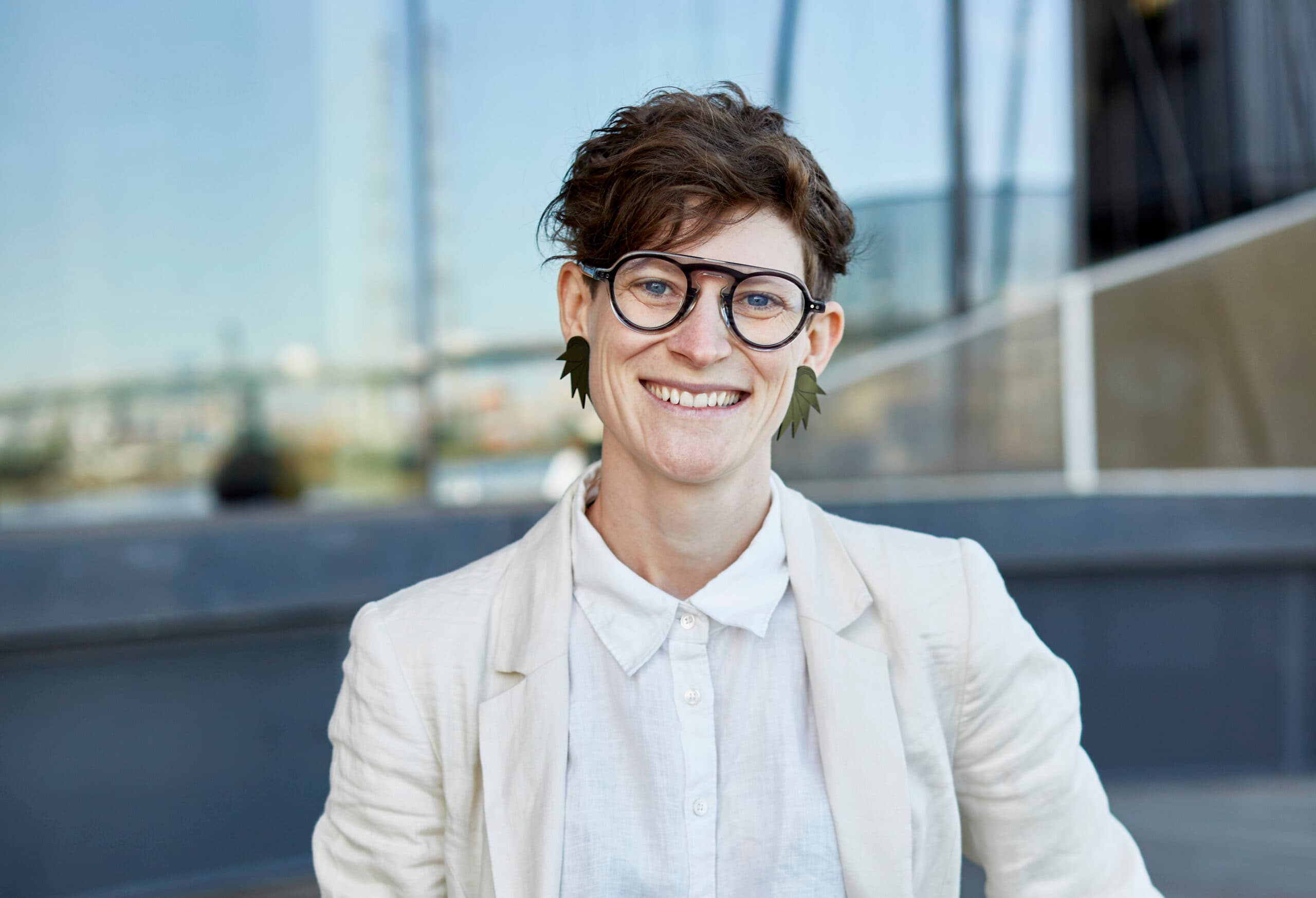
Appointed in 2026, Dr Elise Stephenson is the inaugural Victorian Women’s Trust Feminist Researcher in Residence. She is the Deputy Director of the Global Institute for Women’s Leadership, Australian National University, founded and chaired by former prime minister Julia Gillard. Dr Stephenson is a multi-award-winning gender equality researcher who focuses on gender, sexuality and leadership in policy frontiers, from researching artificial intelligence, to the space sector, diplomacy, national security, intelligence, climate action, international relations, and the Asia Pacific. She is an Australian Research Council Discovery Early Career Researcher Award (DECRA) fellow 2025-2028 for her research on: Gender Equality at the Frontiers: AI, Space and Climate Action. She is the author of two policy briefs on feminist approaches to AI governance, with the International Women’s Development Agency, Australia, and the IE University Center for the Governance of Change, Spain. Her recently published co-authored book, Future Generations Governance, Policymaking and Leadership: Ending “Policrastination” reinforces Elise’s intersectional, intergenerational feminist approach to AI and demonstrates her keen commitment to ensuring her research is translated for policy and practice.
Acknowledgements
We acknowledge the support of Dr Kirsten Abernethy, Ally Oliver-Perham, Leena Van Deventer, Dr Emma McNicol, Luella Geer, Ellie Joyce, Ava Wansbrough, and Rachael Imam from the Victorian Women’s Trust. We also acknowledge the Global Institute for Women’s Leadership, including Ruby Crandell, who leads research assistance on gender and AI, and Dr Jacko Jackson, Dr Leonora Risse and Professor Ramona Vijeyarasa for their help and consultation. We thank all organisations and individuals who contributed to this research, including the members of the VWT Research Circle who provided early feedback.
- eSafety Commissioner (2024). Addressing Deepfake Image-Based Abuse. 24 July. https://www.esafety.gov.au/newsroom/blogs/addressing-deepfake-image-based-abuse
-
UN News (2026). AI is Getting Women Wrong as Gender Bias Persists, Data Reveals. 22 June. https://news.un.org/en/story/2026/06/1167776
-
United Nations (2026). Progress on Sustainable Development Goals: The gender snapshot. 17 Sept. https://www.unwomen.org/en/digital-library/publications/2026/09/progress-on-the-sustainable-development-goals-the-gender-snapshot-2026
-
Cut Through Venture and Folklore Ventures (2025). The State of Australian Startup Funding 2025. https://www.australianstartupfunding.com/
-
United Nations (2026). Preliminary Report of the Independent International Scientific Panel on AI. https://www.un.org/independent-international-scientific-panel-ai/sites/default/files/2026-07/en_Preliminary%20Report_.pdf
-
Deloitte Access Economics and Australian Computer Society (2026). Digital Pulse 2026: Now Shapes Next. https://www.acs.org.au/campaign/digital-pulse.html

Published by the Victorian Women’s Trust, October 2026
© the Victorian Women’s Trust.
Some rights reserved.
137a Queens Parade, Wurundjeri Country
Clifton Hill, VIC, 3068, Australia
T: (03) 9642 0422
women@vwt.org.au
www.vwt.org.au
The Feminist Researcher in Residence Program is a harm prevention initiative of the Dugdale Trust for Women & Girls, of which the Victorian Women’s Trust is sole Trustee.
Open Access. Some rights reserved.
As the publisher of this work, the Victorian Women’s Trust wishes to encourage the circulation of our work as widely as possible while retaining the copyright. We therefore have an open access policy which enables anyone to access our content online without charge. Anyone can download, save, perform or distribute this work in any format, including translation, without written permission.
This is subject to the terms of the Creative Commons By Share Alike licence. The main conditions are:
- The Victorian Women’s Trust and the author(s) are credited including our web address www.vwt.org.au
- If you use our work, you share the results under a similar licence
- A full copy of the licence can be found at https://creativecommons.org/licenses/ by-sa/3.0/legalcode
You are welcome to ask for permission to use this work for purposes other than those covered by the licence. The Victorian Women’s Trust gratefully acknowledges the work of Creative Commons in inspiring our approach to copyright. To find out more go to www.creativecommons.org