- 18th November 2026
- By Ava Wansbrough
Didn’t we win this fight already?
- VWT News
- Policy and Rights
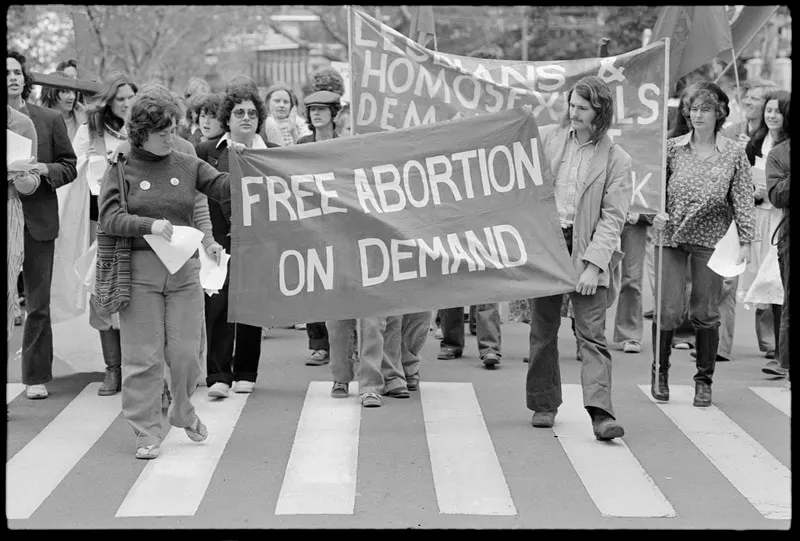
Image: Counter-protesters rally against Mary Whitehouse in Sydney during September 1978. Archival photo from the Search Foundation and State Library of NSW.
At any given Rosie Collective meeting, you’d see a group of young women sitting in a circle, discussing what made them angry. With all the flared corduroy and Gloria Steinem-esque aviator glasses, you’d think we were a consciousness-raising group from the 1970s women’s liberation movement.
And yet in 2026, despite our reliance on smartphones and social media algorithms, we see the same issues repeating: we don’t feel listened to, safe, or respected, and oh yeah, women’s bodies are being politicised again.
The Rosie Collective is a group of young feminists committed to creating action on pressing issues facing young women and gender diverse people.
Rosie is the Victorian Women’s Trust’s youth space. Both digitally and through in-person initiatives like the Rosie Collective, we help young women and gender diverse people make sense of this ever-complicating world and then give them the tools to fight back. This election cycle, after much discussion, we decided to focus on increasing access to abortion for Victorians.
Initially, when the issue of abortion access was raised, a lot of the reaction was “huh” or “oh ok”. The fight for abortion rights seemed a little… retro?
Didn’t we win this fight already? Isn’t abortion already legal?
The issue of abortion access seemed removed from the day-to-day experience of these young women and gender diverse people. And that wasn’t because the issue isn’t pressing, but because we had all assumed that legality equals access. But this isn’t true.
Abortion has been legal in Victoria since 2008, but since then, access to services hasn’t shifted much. This complacency has meant slow progress on abortion access under the Labor state government, in power for the last 12 years.
The more we unpacked the issue, the more cracks within the system were revealed. With the state election on Saturday 28 November, which of the parties will deliver abortion healthcare to those who need it most?
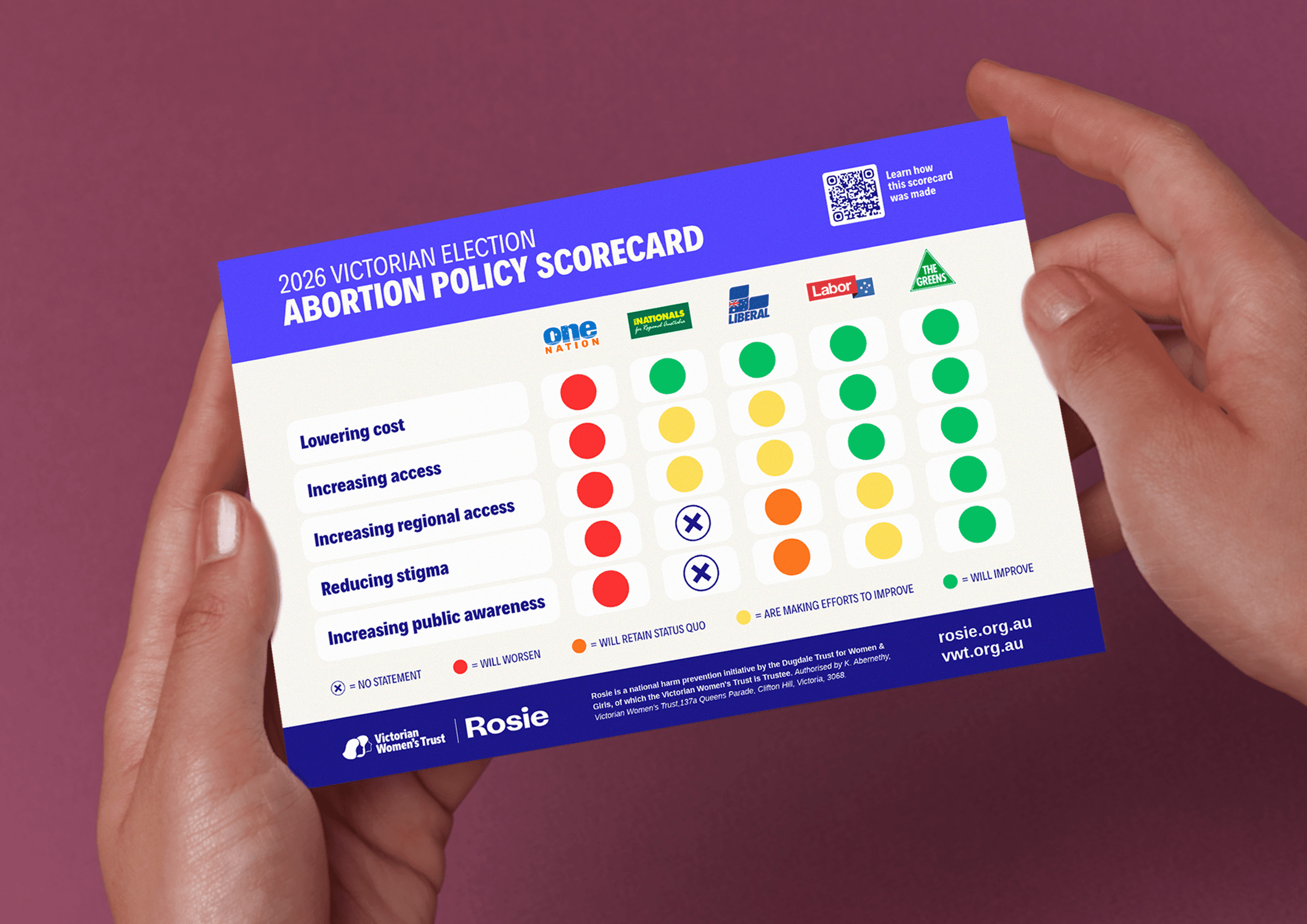
Rosie’s Abortion Policy Scorecard

Inspired by the legacy of feminist activism by the Women’s Electoral Lobby, the Rosie Collective decided to create a scorecard specifically looking at the major parties’ abortion policies.
We were trying to make sense of why – despite 62% of Australians believing in access – abortion is so darn hard to access in this country. This is a national issue, with threats to abortion access by the far right on the rise. This national trend has local impacts, so we zeroed in on the sitch in Vic.
We thought that abortion would be an issue on the smaller side, easy for us to research and contextualise for voters, right? Wrong!
The Rosie team has spent hours talking to experts in the sector, researching and coding on-the-record party positions, voting records, press releases, and statements made by politicians and leaders of the major parties (read the full methodology here).
We categorised our findings under the 5 priority policy areas, and we determined if parties were going to reduce access to abortion, uphold the status quo, or make abortion more accessible if in power.
This was (as it turns out) a mammoth effort. If it took us months of work, how is the average voter supposed to make sense of this?
Well, that’s where we’ve got your back. Our Abortion Policy Scorecard breaks down all the weedy policies so that you can vote with your values.
The Labor Party has made some major policy proposals that would shift the state of abortion access in Vic, and the Coalition has echoed this promise. This would make Victoria the easiest state in Australia to get an abortion. Both parties have promised to:
– Invest $30 million over four years to eliminate out-of-pocket costs for abortion care.
– Pay participating private providers to deliver medical and surgical abortions up to 16 weeks’ gestation.
– Provide a travel subsidy for women living in regional Victoria, given the distance they have to travel to access a clinic.
Labor has also announced it would expand medical abortion access from nine to ten weeks’ gestation, and commission a clinical review into whether it could safely be offered at up to 12 weeks’ gestation, in line with the World Health Organisation’s guidance. The Liberal Party has not committed to this promise.
But is it really that simple?
One Nation’s position is clear: it has a national “pro-life” policy, and its representatives have publicly spread misinformation about abortion, however, the National Party is different. They have published no policy that mentions abortion, and whilst the Federal National Party leader Matt Canavan has been known to espouse anti-abortion views, it is unclear how the party would vote on abortion.
On bills related to abortion, the Liberal Party will allow their MPs to vote with their conscience. So, even if the parties agree to this policy before an election, it can come down to where MPs stand individually. Whilst the Liberal Party has announced their plans to mirror Labor’s policy to make abortion free, with the potential of a Coalition government that could rely on One Nation for the balance of power, a promise alone isn’t a guarantee.
The Rosie Collective has shown how hard it can be to deconstruct and create action on an issue. Now it’s time to keep our MPs accountable for the promises they’ve made.
Abortion is absolutely on the ballot this election – and we have the power to determine which way it goes.
Check out the Rosie Collective Scorecard to see how your vote has the power to make a difference.
Interested in joining the Rosie Collective? Get in touch – we’d love to hear from you! Email ava@vwt.org.au
Didn’t we win this fight already?

Shane O’Neil is making a permanent investment in feminist youth leadership. Here’s why that matters.